
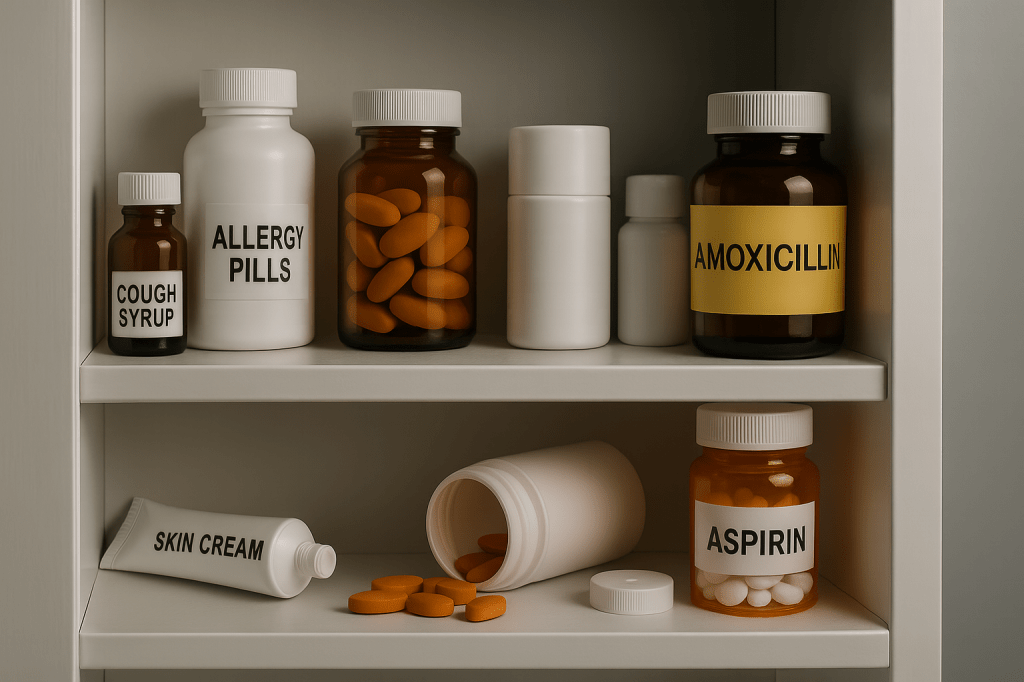
Your medicine cabinet might be hiding more than expired pills and half-used creams.
It might be hiding your next allergic reaction.
Whether it’s a rash, a full-body breakout, or something far more dangerous like anaphylaxis, the problem often starts where we least expect it: inside that bottle we borrowed, that cream we trusted, or those leftover antibiotics we shouldn’t have saved.
Here are the most common and most overlooked allergy triggers sitting on your shelf right now.
Leftover Antibiotics: The “Just-in-Case” Pills That Can Hospitalize You
You know that half-finished bottle of amoxicillin in your bathroom drawer?
Toss it.
One of the most dangerous allergy scenarios I see in my practice is when someone takes an old antibiotic that wasn’t prescribed for them. Most people never finish their entire antibiotic course, and too many leave them around accidentally for others to use.
If the person has or develops a penicillin allergy, even a single dose can trigger a life-threatening reaction. I’ve seen it happen more than once.
The reaction isn’t always immediate. Sometimes that “innocent” first pill sensitizes your body. Then, the next time you get the same drug from your doctor? Boom. Allergic response.
If you want to avoid this, you should:
- Never share prescription meds.
- Properly dispose of unused antibiotics at a pharmacy or through a designated collection program.
- If you’ve ever had a reaction, even a rash, from antibiotics, write it down and tell every provider moving forward.
OTC Pain Relievers: Ibuprofen and Aspirin Aren’t Always Safe
That Advil you grabbed from your aunt’s purse could be the reason you’re breaking out in hives.
Non-steroidal anti-inflammatory drugs (NSAIDs) like ibuprofen and aspirin are common culprits behind allergic skin reactions. I see it monthly. Someone takes a few pills for a headache or joint pain, and hours later, they’re covered in hives or struggling to breathe.
These reactions are hazardous because people don’t think of OTC meds as risky. But for sensitive individuals, they absolutely are.
The safest course you can take is just to keep to the medications you’ve used before without problems. Always avoid “borrowing” meds from others, even if they’re over the counter.
And if you ever get a rash, hives, or wheezing after taking an NSAID, stop immediately and talk to your doctor.
Topical Creams, Lotions, & Tallow: What You Rub On Can Still Wreck Your Skin
You probably assume allergy = pill.
But contact dermatitis, a type of allergy from skin contact, is widely common. I’m talking about the lotions, creams, hydrocortisone, even “natural” products people apply daily.
One recent patient of mine used a popular facial cream. Within days, her eyes were puffy, her skin was inflamed, and her makeup routine was wrecked. Through patch testing, we isolated one ingredient as the trigger. She switched products, and within 48 hours, the rash vanished.
What might surprise you is that beef tallow can also be a culprit.
For people with alpha-gal syndrome, a red meat allergy triggered by tick bites, it can be risky. The fat by itself isn’t always the problem. Alpha-gal reactions are triggered by a specific sugar molecule found in mammalian meat, and it’s usually the protein part of the product, not the fat, that causes issues.
Still, don’t assume safety.
Before slathering beef tallow lotion or any other product on your face, patch-test it on a small section of your forearm and wait for 48 hours. If there’s no redness or itching, it’s likely okay, but proceed cautiously and talk with your allergist.
Inactive Ingredients: The Sneaky Fillers Causing Big Reactions
We tend to focus on the active drug, but often, it’s the so-called “inactive” ingredients that quietly do the damage.
The American Academy of Allergy, Asthma, and Immunology reports that excipients like polyethylene glycol (PEG), propylene glycol, Red #40, and preservatives such as formaldehyde releasers are increasingly recognized as major culprits in both immediate allergic reactions (like anaphylaxis) and delayed ones (like contact dermatitis).
If you’ve ever had mysterious rashes, headaches, or stomach upset after meds, but tested negative for the drug allergy itself, look deeper.
Red Flag Symptoms You Should Never Ignore
Not every reaction is urgent.
While some allergic reactions are immediate and severe (IgE-mediated), others are delayed and develop over hours or even days (T cell–mediated). That means you might not see a rash or swelling until long after the exposure, especially with creams, gels, or extended-use medications.
But if you experience any of the following (even after 2 days of taking meds or cream), stop what you’re doing and get help immediately:
- Sudden shortness of breath
- Wheezing
- Generalized hives across your body
- Swelling in the face or throat
- A rash that gets rapidly worse
If it’s after-hours, don’t wait for a clinic to open. Go to the ER or call poison control. They can often identify pills based on shape or code if you’ve taken something unlabeled.
Safer Alternatives: How to Choose Medications That Won’t Betray You
If you’re sensitive, don’t just “avoid meds.”
Learn how to choose them better. Here’s what I recommend to my patients:
- Stick to medications you’ve tolerated in the past and write them down.
- When possible, choose dye-free, preservative-free, and gelatin-free versions.
- For severe sensitivities or alpha-gal, get your prescriptions compounded (meaning a pharmacy makes a custom version without your known triggers). Insurance should cover it.
- Ask your doctor or pharmacist to flag your chart so that all future medications are vetted for safety.
If you need expert clarity, bring the actual products to your allergist. You can also ask about patch testing for creams, the gold standard for identifying contact allergens.
One Final Thing I Wish Everyone Knew
Allergy reactions often don’t happen the first time.
They happen the second time after you’ve already been sensitized. And if it’s been days since you took or used something? It can still be the cause.
That’s why testing and tracking matter. You should never play guessing games with your health.
Start by cleaning out your medicine cabinet today. Label what’s yours. Toss what’s not. And if you’ve had any weird reactions lately, book that allergy consult.
I am more than happy to help.

