

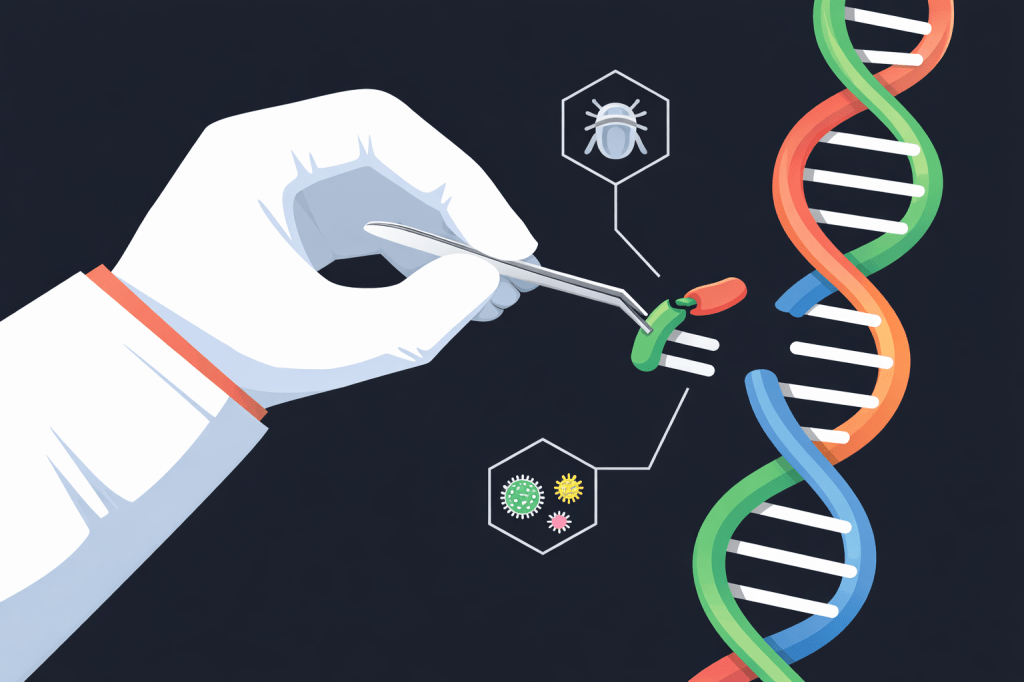
A baby born with a fatal metabolic disorder received a gene edit and walked out of the hospital months later, alive and developing normally.
And if you’re a parent dealing with peanut allergies, asthma, or severe eczema, your next thought is obvious:
Could we do that for allergies, too?
The answer is more complicated and interesting than most headlines suggest.
Let’s walk through what’s real, what’s possible, and what still stands in the way.
What CRISPR actually does (in plain English)
CRISPR (Clustered Regularly Interspaced Short Palindromic Repeats) is a very precise tool.
At its core, it lets scientists do three things inside your DNA:
- Find a specific location
- Cut the DNA at that exact spot
- Remove or replace a piece of genetic code
Think of it like editing a single sentence inside a massive book without touching the rest.
Scientists use a guide RNA to find the exact address in your DNA, and an enzyme called Cas9 to make the cut. Once that cut is made, the cell tries to repair itself, and that’s where we can step in and change the outcome.
Here’s the important part most people miss.
Your DNA lives inside the nucleus of the cell. That’s the control center. The body protects it like Fort Knox. So getting CRISPR machinery into that space, cutting the DNA, and repairing it correctly requires a controlled, high-risk operation.
When it works, it can address the root cause of a disease rather than just manage symptoms.
That’s why the baby case matters so much because it worked.
Why CRISPR works for some diseases… and not others
CRISPR shines when a disease has one clear genetic mistake.
Some examples are:
- Sickle cell disease
- Certain immune deficiencies
- Some rare metabolic disorders
In those cases, there’s one broken instruction. Fix it, and the system runs properly again.
Unfortunately, allergies are not built that way. They’re vastly more complex, like a computer network, rather than a single switch.
When someone has a peanut allergy or asthma, multiple systems are involved:
- Immune signaling pathways
- IgE antibody production
- Cytokines like interleukins
- Environmental exposure history
- Epigenetic factors (more on that in a second)
That means there isn’t one clean target.
In many cases, we don’t even know which gene we’d need to edit in the first place. It’s more like trying to fix a hundred small wiring issues instead of replacing one broken fuse.
The hidden layer most people don’t know about: epigenetics
Even if you edit a gene correctly, that doesn’t guarantee the body will behave differently.
DNA just doesn’t operate in isolation.
Around your DNA are structures called histones and other regulatory elements. These control whether a gene is turned on or off. You can think of them as access controls.
So you could fix a gene perfectly, but if the surrounding environment still tells the body to express allergic responses, the problem may continue.
This is one of the biggest reasons CRISPR is not a simple fix for allergies today.
Are people “born allergic,” or does environment matter?
Both.
You can be born with a predisposition, but exposure also can shape the outcome.
A few examples we see repeatedly:
- Infants exposed to farm environments early often develop fewer allergies
- Early dog exposure can reduce allergy risk
- Certain indoor exposures (like cats in some cases) can increase it
What does that tell us?
Allergy is a gene-environment interaction.
You can’t fix it easily by just editing DNA. You’re trying to override years of immune conditioning.
That’s a much harder problem.
Where CRISPR could help in allergy and immunology
Now here’s where things get interesting.
Even if we can’t “turn off” allergies completely, there are areas where CRISPR could have a real impact.
1. Fixing immune system defects
Some patients are missing key immune functions entirely.
In those cases, CRISPR can insert the correct gene, restore a proper immune response, and eliminate lifelong treatments such as IV infusions.
We’re already seeing this in conditions like severe combined immunodeficiency, where inserting a single working gene allows the body to produce normal immune cells again.
2. Targeting inflammatory pathways
If we can identify dominant pathways in a patient (for example, specific cytokines driving disease), gene editing might reduce overreaction.
But again, this depends on identifying the right target. The challenge is that in allergy, the “driver” isn’t always the same. One patient responds to blocking IL-4, while another needs IL-13.
That variability makes gene-level targeting much harder.
3. Precision immune cell engineering
This is already being explored in cancer, where we’re modifying T-cells to hunt down abnormal cells.
That same idea, retraining the immune system, could eventually apply to allergic responses, training the immune system not to overreact.
The ethical line: Should we create “allergy-free babies”?
There’s a growing probability we can create babies without any defects, including allergies.
There’s already Silicon-backed start-ups exploring “Designer Babies.”
But just like with the Jurassic Park movies, it’s not about whether or not we can perform such a scientific feat, but if we should.
We simply don’t fully understand all the genetic pathways involved or the long-term effects of editing DNA in babies. The fatal disease in the newborn made the risk-benefit equation in favor of CRISPR, as there was nothing less to lose.
But for healthy babies? Is that ethical? What if you mess up, and the outcome is fatal or leads to permanent, negative effects?
There’s also a deeper issue.
Once you start editing traits like allergy risk, you open the door to selecting other traits. Eye color, height, cognitive traits, and skin color.
We will run headlong into eugenics.
The economic reality nobody talks about
CRISPR treatments today can cost around $1 million per patient.
That will come down over time, but there’s another factor at play.
Chronic diseases—like allergies and asthma—generate ongoing revenue through medications and treatments. If you cure the condition once, that revenue disappears.
That creates a strange tension in the system. On one hand, there’s a massive incentive to innovate. On the other, there’s less financial incentive to eliminate a condition that can be managed long-term.
So it’s anyone’s guess how that will play out (and how soon costs could go down).
What the next 10 years will likely look like
Here’s where I think this is headed.
More adult treatments will be first, which we’re already seeing. Then there will be an expansion into rare genetic immune disorders, followed by gradual refinement using AI to speed up discovery.
The result will be more precise, patient-specific therapies. Instead of running 100,000 lab experiments, researchers will be able to simulate outcomes and narrow down the most promising approaches faster.
That accelerates everything.
But even with that progress, allergies will likely remain complex for a while.
What I tell patients right now
CRISPR is powerful, and it’s going to change medicine.
It’s building toward a future where we treat disease at the root instead of managing symptoms.
We’re just not there yet for allergies.
Could we one day reduce or eliminate allergy risk at the genetic level?
Yes.
But the first real wins will come from simpler targets. And those will teach us how to handle the complexity that comes next.

