

Women are seeing it everywhere on their feeds.
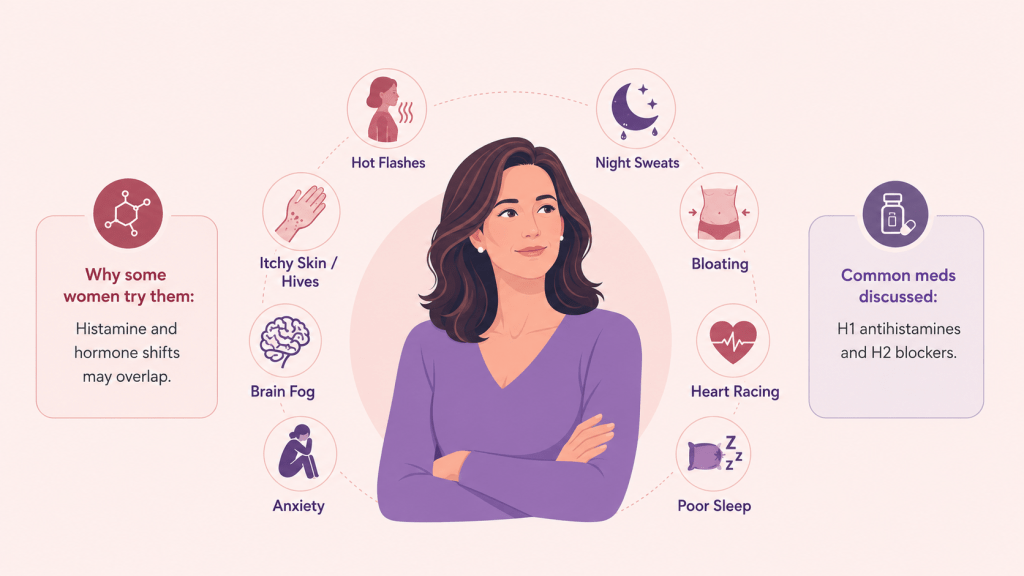
Across TikTok, Instagram, Reddit, and health podcasts, more women are talking about using allergy medications and acid reducers to calm symptoms they believe are tied to perimenopause.
They claim to reduce hot flashes, night sweats, itchy skin, bloating, and even anxiety.
But why would an allergy pill help a hormone problem? And is it safe?
Here’s everything you need to know:
Perimenopause is not just “getting older”
Perimenopause is the transition into menopause.
For many women, it starts in the 40s, though the timing varies, as do the symptoms:
- Irregular periods
- Broken sleep
- Pounding heart in the dead of night
- Hot flashes in the middle of a workday
For decades, too many women were told, “That’s just menopause,” then sent home.
But it’s much more complex than that.
Perimenopause is driven by hormone fluctuation, especially changes in estrogen and progesterone. Those hormones affect the uterus, but they also impact blood vessels, skin, sleep, mood, digestion, and the immune system.
That is why the connection to allergies deserves attention.
Where histamine fits into this conversation
Histamine is one of the main chemicals involved in allergic reactions.
When histamine is released, blood vessels open, leading to flushed skin, a runny nose, and a cramped gut. Even the brain can feel suddenly wrapped in wet cotton.
In an allergic person, histamine is part of the reason they sneeze around ragweed, break out in hives after a trigger, or feel miserable during cedar season.
There appears to be a real connection to women’s hormones, though the exact relationship is still not fully mapped.
Mast cells, the immune cells that release histamine, appear to interact with estrogen and progesterone. They have receptors that respond to these hormones.
So when hormone levels rise, fall, or fluctuate unpredictably, the mast cell may become more easily irritated.
While that does not prove every hot flash is a histamine problem, it does mean there is something to this online trend.
Why the symptoms overlap so much
The reason this trend has exploded is that perimenopause symptoms and mast cell symptoms can look almost identical.
A woman may say, “I’m flushing, itching, bloated, exhausted, foggy, and waking up drenched at night.”
That could be:
- hormonal
- allergic
- mast cell activation
- or several problems stacked on top of each other
That overlap is why women are experimenting with H1 blockers, such as common antihistamines, and H2 blockers, such as famotidine, which is often used for acid reflux.
In mast cell conditions, doctors often use H1 blockers, H2 blockers, and leukotriene blockers to calm different parts of the reaction.
So yes, there is a medical reason people are trying this.
But the missing piece is proof.
What we know and what we do not know
There is a difference between a plausible mechanism and a proven treatment plan.
The mechanism makes sense. Hormones can influence mast cells, which then release histamine that can cause flushing, itching, gut symptoms, headache, and brain fog.
But we do not have strong clinical trials showing that women with perimenopause symptoms should take a specific antihistamine, at a specific dose, for a specific number of months.
Unfortunately, a trend can be based on a real signal and still run ahead of the evidence. That is where patients get into trouble, and where we need to be cautious.
The body is not a vending machine. You do not put in Zyrtec and automatically get fewer hot flashes.
And speaking of medications…
The Benadryl problem
If there is one warning I would give, it is this: do not turn Benadryl into your nightly perimenopause plan.
Diphenhydramine, the ingredient in Benadryl, is an older antihistamine. It crosses into the brain more easily, which is why it can knock people out.
That sedation is also the problem.
In older adults, long-term use of strong anticholinergic medications has been linked with a higher risk of cognitive problems and dementia. Benadryl falls into that category.
Of course, that does not mean one emergency dose destroys your brain. But if you use it casually, night after night, because a social media clip told you to “block histamine,” it is a bad long-term plan.
If you need an antihistamine, ask your doctor about less sedating options.
Or if your main symptoms are nasal congestion, sneezing, postnasal drip, sinus pressure, or a runny nose, a nasal spray may work better than an oral antihistamine.
Track for 30 days before you declare victory
If you and your doctor decide to try an H1 blocker, an H2 blocker, a nasal spray, a low-histamine diet, or a lifestyle change, track it for one month.
Whatever you do, don’t guess.
Write down your sleep, flushing, hives, bloating, meals, alcohol, stress, cycle changes, medications, and allergy exposures. If cedar pollen is high, your dog sleeps on your pillow, and you drank red wine before bed, write them down.
A low-histamine diet may help certain patients, especially those with flushing, hives, headaches, or gut symptoms.
It may also be worth asking your doctor about estrogen, progesterone, and testosterone levels. Women make testosterone too, just at lower levels than men, and the balance between these hormones may matter more than many patients realize.
No matter what, just change one major variable at a time. Then look at the pattern and discuss it with your doctor.
A wise way of looking at the trend
If anything, this trend has highlighted the importance of paying attention to the body’s clues.
Histamine may be part of the perimenopause story for some women. But the safest path is simple:
- identify the symptoms,
- rule out the dangerous causes,
- run a supervised trial,
- track the results,
- and do not use Benadryl as a nightly shortcut.
That is much smarter and safer than just following the whims of a viral trend.

